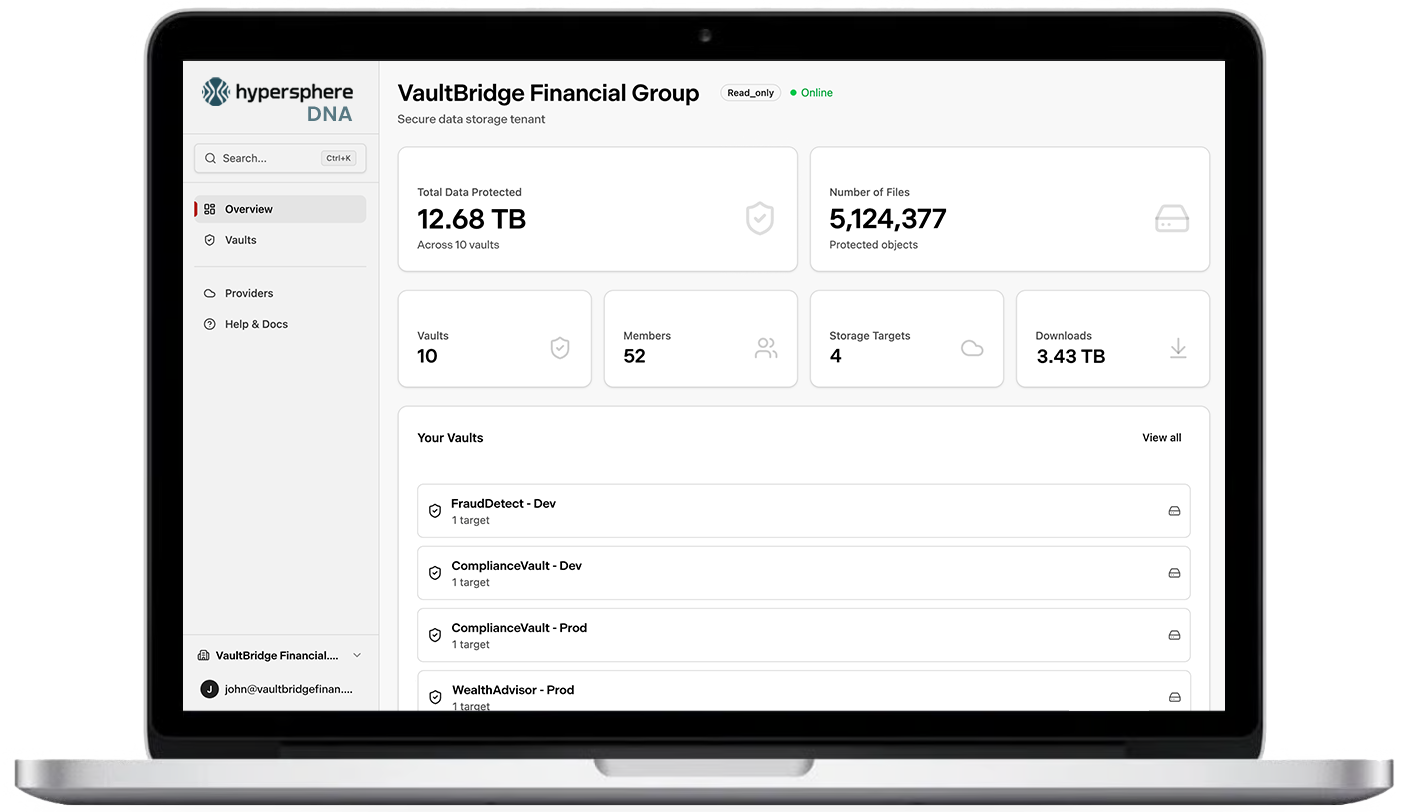
Data security that works
when everything else fails.
S3 credentials compromised? No problem. With HyperSphere, attackers walk away with unusable data.
HyperSphere DNA™ (Data Neutralization Appliance) for AWS is now available in AWS Marketplace · Read the press release










Unbreachable is a myth.
We make stolen data useless.
Data Neutralization is the security posture that assumes breach is inevitable and renders exfiltrated data cryptographically inert. The question is no longer "how do we keep them out?" It's "what do they get when they're in?" With HyperSphere, the answer is unreadable data.
Production-ready in minutes. Anywhere.

HyperSphere drops in between applications and S3-compatible object storage to encrypt/decrypt data in cloud, on-prem, edge, or offline environments. Now available in AWS Marketplace — deployed in minutes on AWS.
No keys to store, manage, lose, or steal.
No human has to deal with encryption keys — ever. Keys are ephemeral. They exist only for the microseconds they're needed, then they're gone. No room for errors that end in downtime or audit findings.
Stolen data is genuinely unusable.
Protection is quantum-resistant and enforced architecturally, not by policies or credentials alone. If storage is breached, attackers get nothing usable. Authorized users continue working seamlessly.
The breach economy is a system, not a series of incidents.
Stolen data has a market. It gets packaged, priced, and resold — often for years after the original breach. Cybersecurity Ventures projects annual cybercrime damages at $10.5 trillion; if it were a country, it would be the world's third-largest economy. And the visible numbers are a floor, not a ceiling: when the FBI seized the Hive ransomware group's infrastructure, only ~20% of its victims had ever reported the attack.
The entire model depends on one thing: the data being readable once taken. Remove that property, and the model collapses.
Encryption held. Key custody failed.
In every major breach of the past decade, the data was already encrypted. The algorithm held. Key custody failed. That conversion — from stolen bytes to readable records — is the business model of the breach economy. It is the specific thing Data Neutralization eliminates.
LastPass, 2022
Attackers obtained KMS keys from a compromised engineer's workstation and decrypted previously exfiltrated S3 backups. Encryption held. Key custody failed.
Capital One, 2019
One over-permissioned IAM role with S3 read + KMS decrypt. 100M+ records read in plaintext. Encryption held. Key custody failed.
Change Healthcare, 2024
One stolen credential, one portal without MFA. 100M patient records; ~$2.457B in total costs per the company's own disclosures. Encryption held. Key custody failed.
Encryption needs to last. Keys don't.
HyperSphere DNA (Data Neutralization Appliance) seamlessly protects data before it's written to storage and as users work. Deploys in minutes with zero code changes. Keys are never stored. There is no key store to compromise. An exfiltrated backend yields only replicated ciphertext.
Built for wherever the stakes are highest.
Enterprise & Commercial
Financial services, healthcare, and AI infrastructure — where a compromised credential shouldn't mean a regulatory event.
Explore use cases by industry — financial services, healthcare, and AI infrastructure — and see the board-level, compliance, and cost arguments for each.
Defense & Government
Tactical edge, CUI/CMMC, and harvest-now-decrypt-later — where the adversary is a nation-state, not a criminal market.
See the mission-level case: dwell time, disconnected operations, and quantum-era data protection for national security missions.
Wherever encryption keys persist, there's exposure.
Traditional KMS automates a lot. But it also centralizes key custody and stores a root key. Keys are targets. A compromised root key or privileged credential exposes everything encrypted under it.
89% of breaches involve valid credentials.
Attackers don't break encryption — they steal the keys. Stolen credentials, insider access, or a compromised root key exposes everything encrypted under it — instantly and completely. (IBM Cost of a Data Breach Report 2024)
"Harvest Now, Decrypt Later" is happening.
Adversaries are exfiltrating your encrypted data today, betting that quantum computing will crack the keys tomorrow. Every month of persistent keys is another month of compounding exposure.
Complex systems create the conditions for human error.
Key ceremonies, rotation schedules, IAM policies, access reviews — every manual process is a failure waiting to happen. Misconfigured permissions, stale keys, undocumented changes. The more moving parts in your KMS, the more ways it can go wrong.
What your team gets back immediately.
Engineering time reclaimed to focus on security and development.
Your security and DevSecOps teams can focus on actual threats — and stop wasting time on key management, rotation, and remediation.
Key management costs, complexities, and bottlenecks eliminated.
No KMS API call costs. No latency for users to complain about. No IAM clutter. No superfluous infrastructure to maintain. Just savings from day one.
Post-Quantum Cryptography (PQC) migration project postponed — indefinitely.
AES-256-GCM and HMAC-SHA256 today. No public-key crypto in the data path. No years-long migration required. Ready when quantum arrives.
Better than the alternatives.
We don't compete with prevention vendors or recovery vendors. Prevention stops attackers from getting in; recovery restores operations after. Data Neutralization addresses what the attacker gets when they succeed — which they will. Every alternative still leaves keys somewhere they can be found. HyperSphere doesn't.
Zero trust governs who can access data. Data Neutralization governs what value the attacker extracts when access is compromised. Different layers, complementary architectures.
AWS KMS, Azure Key Vault, HashiCorp Vault
- Root key persists — a single point of catastrophic failure
- Per-operation API calls add cost and latency at scale
- Privileged credential compromise exposes everything encrypted under it
- Key rotation requires scheduling, coordination, and downtime risk
Calamu, Myota, ShardSecure
- Still rely on traditional key management for decryption and reassembly
- Keys exist and can be stolen — there's still a key store to breach
- Fragmentation is a resilience strategy, not a cryptographic enforcement model
- No key hierarchy isolation — distribution and encryption are separate concerns
Encryption + distribution + ephemeral keying — all automated
- Keys derived in memory, destroyed after use — never stored on disk
- AES-256-GCM encryption on every frame — not just fragmentation
- Stolen ciphertext from any single backend is genuinely useless
- Key "rotation" is automatic, zero-downtime, built into the architecture
- No per-GB metering — flat within your tier
Recognized, Listed, and Deployed.

Gartner
12× recognized by Gartner for our unique approach to data protection.
NIST-Listed
HyperSphere security configuration guidance is listed in the NIST National Checklist Program.

Cubic DTECH
Deployed in DoD tactical edge platforms where managing keys isn't operationally possible.

Forward Edge-AI
Bringing HyperSphere DNA to distributed AI infrastructure.
Ready to eliminate key management risk?
Get a live walkthrough of HyperSphere DNA with a HyperSphere engineer. We'll show you exactly how data neutralization works — and what it eliminates from your stack.